


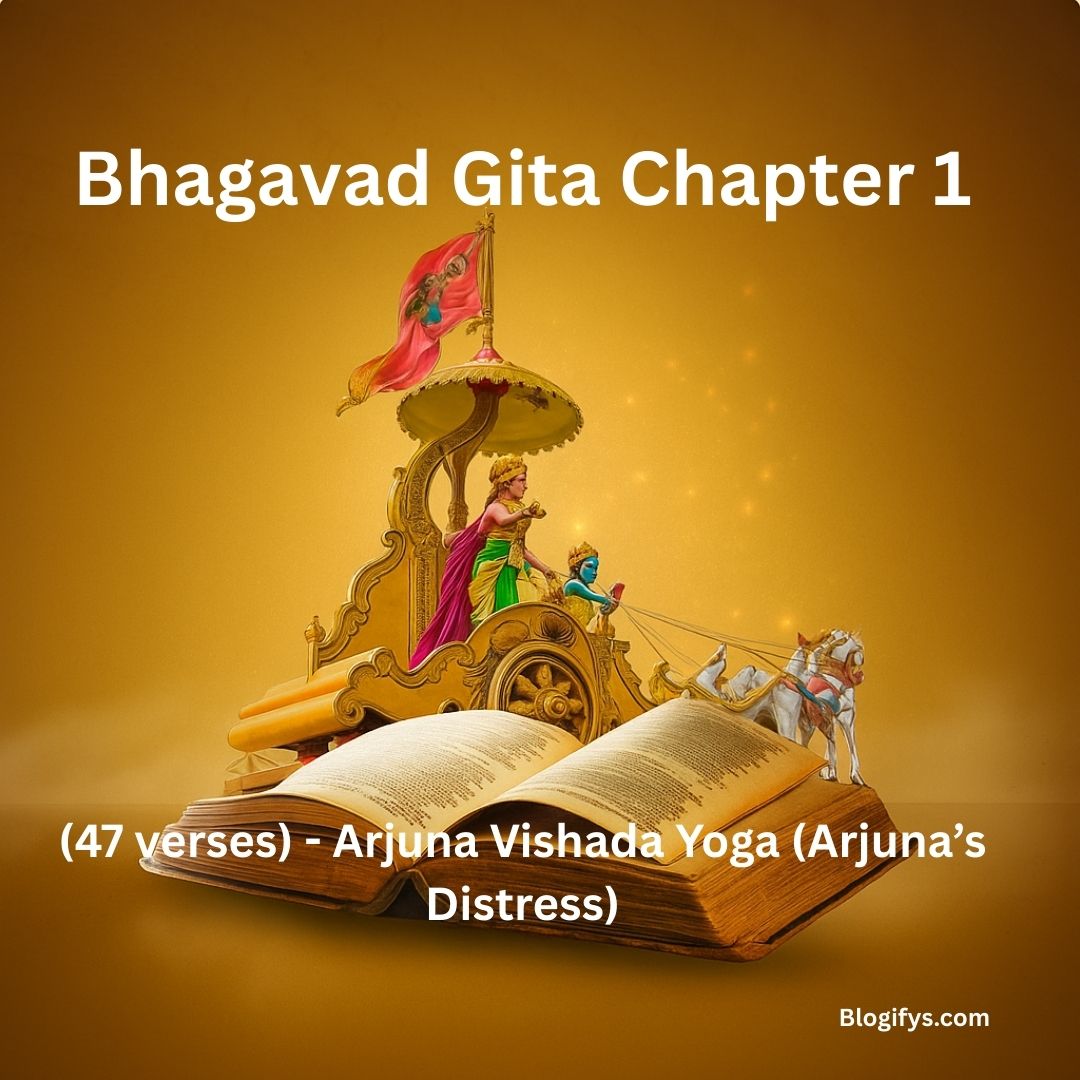
Bhagavad Gita Chapter 1(Part-3) – Arjuna Vishada Yoga (Arjuna’s Distress)
Verse 25
भीष्मद्रोणप्रमुखतः सर्वेषां च महीक्षिताम् ।
उवाच पार्थ पश्यैतान् समवेतान् कुरूनिति ॥ २५ ॥
In the presence of Bhéñma, Droëa and all other chieftains of the world,
Håñékeça, the Lord, said, Just behold, Pärtha, all the Kurus who are assembled
here.
As the Supersoul of all living entities, Lord Kåñëa could understand what
was going on in the mind of Arjuna. The use of the word Håñékeça in this
connection indicates that He knew everything. And the word Pärtha, or the
son of Kunté or Påthä, is also similarly significant in reference to Arjuna. As a
friend, He wanted to inform Arjuna that because Arjuna was the son of Påthä,
the sister of His own father Vasudeva, He had agreed to be the charioteer of
Arjuna. Now what did Kåñëa mean when He told Arjuna to “behold the
Kurus”? Did Arjuna want to stop there and not fight? Kåñëa never expected
such things from the son of His aunt Påthä. The mind of Arjuna was thus
predicated by the Lord in friendly joking
Verse 26
तत्रापश्यत्स्थितान् पार्थः पितॄनथ पितामहान्।
आचार्यान् मातुलान्भ्रातॄन् पुत्रान्पौत्रान्सखींस्तथा॥
श्वशुरान् सुहृदश्चैव सेनयोरुभयोरपि॥ २६॥
There Arjuna could see, within the midst of the armies of both parties, his
fathers, grandfathers, teachers, maternal uncles, brothers, sons, grandsons,
friends, and also his father-in-law and well-wishers—all present there.
On the battlefield Arjuna could see all kinds of relatives. He could see
persons like Bhüriçravä, who were his father’s contemporaries, grandfathers
Bhéñma and Somadatta, teachers like Droëäcärya and Kåpäcärya, maternal
uncles like Çalya and Çakuni, brothers like Duryodhana, sons like Lakñmaëa,
friends like Açvatthämä, well-wishers like Kåtavarmä, etc. He could see also
the armies which contained many of his friends.
Verse 27
ताञ् समीक्ष्य स कौन्तेयः सर्वान्बन्धूनवस्थितान् ।
कृपया परयाविष्टो विषीदन्निदमब्रवीत् ॥ 27 ॥
When the son of Kunté, Arjuna, saw all these different grades of friends and
relatives, he became overwhelmed with compassion and spoke thus:
Verse 28
अर्जुन उवाच
दृष्ट्वेमं स्वजनं कृष्ण युयुत्सुं समुपस्थितम् ।
सीदन्ति मम गात्राणि मुखं च परिशुष्यति ॥ २८ ॥
Arjuna said: My dear Kåñëa, seeing my friends and relatives present before me
in such a fighting spirit, I feel the limbs of my body quivering and my mouth
drying up.
Any man who has genuine devotion to the Lord has all the good qualities
which are found in godly persons or in the demigods, whereas the nondevotee,
however advanced he may be in material qualifications by education and
culture, lacks in godly qualities. As such, Arjuna, just after seeing his kinsmen,
friends and relatives on the battlefield, was at once overwhelmed by
compassion for them who had so decided to fight amongst themselves. As far
as his soldiers were concerned, he was sympathetic from the beginning, but he
felt compassion even for the soldiers of the opposite party, foreseeing their
imminent death. And so thinking, the limbs of his body began to quiver, and
his mouth became dry. He was more or less astonished to see their fighting
spirit. Practically the whole community, all blood relatives of Arjuna, had
come to fight with him. This overwhelmed a kind devotee like Arjuna.
Although it is not mentioned here, still one can easily imagine that not only
were Arjuna’s bodily limbs quivering and his mouth drying up, but that he was
also crying out of compassion. Such symptoms in Arjuna were not due to
weakness but to his softheartedness, a characteristic of a pure devotee of the
Lord. It is said therefore:
यस्यास्ति भक्तिर्भगवत्यकिञ्चना
सर्वैर् गुणैस्तत्र समासते सुराः ।
हरावभक्तस्य कुतो महद्गुणाः
मनोरथेनासति धावतो बहिः ॥
“One who has unflinching devotion for the Personality of Godhead has all
the good qualities of the demigods. But one who is not a devotee of the Lord
has only material qualifications that are of little value. This is because he is
hovering on the mental plane and is certain to be attracted by the glaring
material energy.”
Verse 29
वेपथुश्च शरीरे मे रोमहर्षश्च जायते ।
गाण्डीवं स्रंसते हस्तात्त्व क्क चैव परिदह्यते ॥ २९ ॥
My whole body is trembling, and my hair is standing on end. My bow Gäëòéva
is slipping from my hand, and my skin is burning.
There are two kinds of trembling of the body, and two kinds of standings of
the hair on end. Such phenomena occur either in great spiritual ecstasy or out
of great fear under material conditions. There is no fear in transcendental
realization. Arjuna’s symptoms in this situation are out of material fear—
namely, loss of life. This is evident from other symptoms also; he became so
impatient that his famous bow Gäëòéva was slipping from his hands, and,
because his heart was burning within him, he was feeling a burning sensation
of the skin. All these are due to a material conception of life.
Verse 30
न च शक्नोम्यवस्थितुं भ्रमतीव च मे मनः ।
निमित्तानि च पश्यामि विपरीतानि केशव ॥ ३० ॥
I am now unable to stand here any longer. I am forgetting myself, and my mind
is reeling. I foresee only evil, O killer of the Keçé demon.
Due to his impatience, Arjuna was unable to stay on the battlefield, and he
was forgetting himself on account of the weakness of his mind. Excessive
attachment for material things puts a man in a bewildering condition of
existence. Bhayaà dvitéyäbhiniveçataù: such fearfulness and loss of mental
equilibrium take place in persons who are too affected by material conditions.
Arjuna envisioned only unhappiness in the battlefield—he would not be
happy even by gaining victory over the foe. The word nimitta is significant.
When a man sees only frustration in his expectations, he thinks, “Why am I
here?” Everyone is interested in himself and his own welfare. No one is
interested in the Supreme Self. Arjuna is supposed to show disregard for selfinterest by submission to the will of Kåñëa, who is everyone’s real self-interest.
The conditioned soul forgets this, and therefore suffers material pains. Arjuna
thought that his victory in the battle would only be a cause of lamentation for
him.
Verse 31
न च श्रेयोऽनुपश्यामि हत्वा स्वजनम् आहवे ।
न काङ्क्षे विजयं कृष्ण न च राज्यं सुखानि च ॥ 1.31 ॥
I do not see how any good can come from killing my own kinsmen in this battle,
nor can I, my dear Kåñëa, desire any subsequent victory, kingdom, or
happiness.
Without knowing that one’s self-interest is in Viñëu (or Kåñëa),
conditioned souls are attracted by bodily relationships, hoping to be happy in
such situations. Under delusion, they forget that Kåñëa is also the cause of
material happiness. Arjuna appears to have even forgotten the moral codes for
a kñatriya. It is said that two kinds of men, namely the kñatriya who dies
directly in front of the battlefield under Kåñëa’s personal orders and the
person in the renounced order of life who is absolutely devoted to spiritual
culture, are eligible to enter into the sun-globe, which is so powerful and
dazzling. Arjuna is reluctant even to kill his enemies, let alone his relatives. He
thought that by killing his kinsmen there would be no happiness in his life,
and therefore he was not willing to fight, just as a person who does not feel
hunger is not inclined to cook. He has now decided to go into the forest and
live a secluded life in frustration. But as a kñatriya, he requires a kingdom for
his subsistence, because the kñatriyas cannot engage themselves in any other
occupation. But Arjuna has had no kingdom. Arjuna’s sole opportunity for
gaining a kingdom lay in fighting with his cousins and brothers and reclaiming
the kingdom inherited from his father, which he does not like to do. Therefore
he considers himself fit to go to the forest to live a secluded life of frustration.
Verse 32–35
किं नो राज्येन गोविन्द किं भोगैर्जीवितेन वा ।
येषामर्थे काङ्क्षितं नो राज्यं भोगाः सुखानि च ॥ 1.32 ॥
त इमेऽवस्थिताः युद्धे प्राणांस्त्यक्त्वा धनानि च ।
आचार्याः पितरः पुत्रास्तथैव च पितामहाः ॥ 1.33 ॥
मातुलाः श्वशुराः पौत्राः श्यालाः सम्बन्धिनस्तथा ।
एतान्न हन्तुमिच्छामि घ्नतोऽपि मधुसूदन ॥ 1.34 ॥
अपि त्रैलोक्यराज्यस्य हेतोः किं नु महीकृते ।
निहत्य धार्तराष्ट्रान्नः का प्रीतिः स्याज्जनार्दन ॥ 1.35 ॥
O Govinda, of what avail to us are kingdoms, happiness or even life itself when
all those for whom we may desire them are now arrayed in this battlefield? O
Madhusüdana, when teachers, fathers, sons, grandfathers, maternal uncles,
fathers-in-law, grandsons, brothers-in-law and all relatives are ready to give up
their lives and properties and are standing before me, then why should I wish to
kill them, though I may survive? O maintainer of all creatures, I am not
prepared to fight with them even in exchange for the three worlds, let alone this
earth.
Arjuna has addressed Lord Kåñëa as Govinda because Kåñëa is the object of
all pleasures for cows and the senses. By using this significant word, Arjuna
indicates what will satisfy his senses. Although Govinda is not meant for
satisfying our senses, if we try to satisfy the senses of Govinda then
automatically our own senses are satisfied. Materially, everyone wants to
satisfy his senses, and he wants God to be the order supplier for such
satisfaction. The Lord will satisfy the senses of the living entities as much as
they deserve, but not to the extent that they may covet. But when one takes
the opposite way—namely, when one tries to satisfy the senses of Govinda
without desiring to satisfy one’s own senses—then by the grace of Govinda all
desires of the living entity are satisfied. Arjuna’s deep affection for community
and family members is exhibited here partly due to his natural compassion for
them. He is therefore not prepared to fight. Everyone wants to show his
opulence to friends and relatives, but Arjuna fears that all his relatives and
friends will be killed in the battlefield, and he will be unable to share his
opulence after victory. This is a typical calculation of material life. The
transcendental life is, however, different. Since a devotee wants to satisfy the
desires of the Lord, he can, Lord willing, accept all kinds of opulence for the
service of the Lord, and if the Lord is not willing, he should not accept a
farthing. Arjuna did not want to kill his relatives, and if there were any need
to kill them, he desired that Kåñëa kill them personally. At this point he did
not know that Kåñëa had already killed them before their coming into the
battlefield and that he was only to become an instrument for Kåñëa. This fact
is disclosed in following chapters. As a natural devotee of the Lord, Arjuna did
not like to retaliate against his miscreant cousins and brothers, but it was the
Lord’s plan that they should all be killed. The devotee of the Lord does not
retaliate against the wrongdoer, but the Lord does not tolerate any mischief
done to the devotee by the miscreants. The Lord can excuse a person on His
own account, but He excuses no one who has done harm to His devotees.
Therefore the Lord was determined to kill the miscreants, although Arjuna
wanted to excuse them.
Verse 36
पापमेवाश्रयेदस्मान्ह त्वैतान् आततायिनः ।
तस्मान्नार्हा वयं हन्तुं धार्तराष्ट्रान् सबान्धवान् ॥
स्वजनं हि कथं हत्वा सुखिनः स्याम माधव ॥ ३६ ॥
Sin will overcome us if we slay such aggressors. Therefore it is not proper for us
to kill the sons of Dhåtaräñöra and our friends. What should we gain, O Kåñëa,
husband of the goddess of fortune, and how could we be happy by killing our
own kinsmen?
According to Vedic injunctions there are six kinds of aggressors: 1) a poison
giver, 2) one who sets fire to the house, 3) one who attacks with deadly
weapons, 4) one who plunders riches, 5) one who occupies another’s land, and
6) one who kidnaps a wife. Such aggressors are at once to be killed, and no sin
is incurred by killing such aggressors. Such killing of aggressors is quite
befitting for any ordinary man, but Arjuna was not an ordinary person. He
was saintly by character, and therefore he wanted to deal with them in
saintliness. This kind of saintliness, however, is not for a kñatriya. Although a
responsible man in the administration of a state is required to be saintly, he
should not be cowardly. For example, Lord Räma was so saintly that people
were anxious to live in His kingdom, (Räma-räjya), but Lord Räma never
showed any cowardice. Rävaëa was an aggressor against Räma because he
kidnapped Räma’s wife, Sétä, but Lord Räma gave him sufficient lessons,
unparalleled in the history of the world. In Arjuna’s case, however, one should
consider the special type of aggressors, namely his own grandfather, own
teacher, friends, sons, grandsons, etc. Because of them, Arjuna thought that he
should not take the severe steps necessary against ordinary aggressors. Besides
that, saintly persons are advised to forgive. Such injunctions for saintly
persons are more important than any political emergency. Arjuna considered
that rather than kill his own kinsmen for political reasons, it would be better
to forgive them on grounds of religion and saintly behavior. He did not,
therefore, consider such killing profitable simply for the matter of temporary
bodily happiness. After all, kingdoms and pleasures derived therefrom are not
permanent, so why should he risk his life and eternal salvation by killing his
own kinsmen? Arjuna’s addressing of Kåñëa as “Mädhava,” or the husband of
the goddess of fortune, is also significant in this connection. He wanted to
point out to Kåñëa that, as husband of the goddess of fortune, He should not
have to induce Arjuna to take up a matter which would ultimately bring about
misfortune. Kåñëa, however, never brings misfortune to anyone, to say nothing
of His devotees.