

Bhagavad Gita Chapter 1(Part-2) – Arjuna Vishada Yoga (Arjuna’s Distress)
Verse 13
ततः शङ्खाश्च भेर्यश्च पणवानकगोमुखाः।
सहसैवाभ्यनद्यन्त स शब्दस्तुमुलोऽभवत्॥ 13 ॥
After that, the conchshells, bugles, trumpets, drums and horns were all
suddenly sounded, and the combined sound was tumultuous.
Verse 14
ततः श्वेतैर्हयैर्युक्ते महति स्यन्दने स्थितौ ।
माधवः पाण्डवश्चैव दिव्यौ शङ्खौ प्रदध्मतु: ॥ १४ ॥
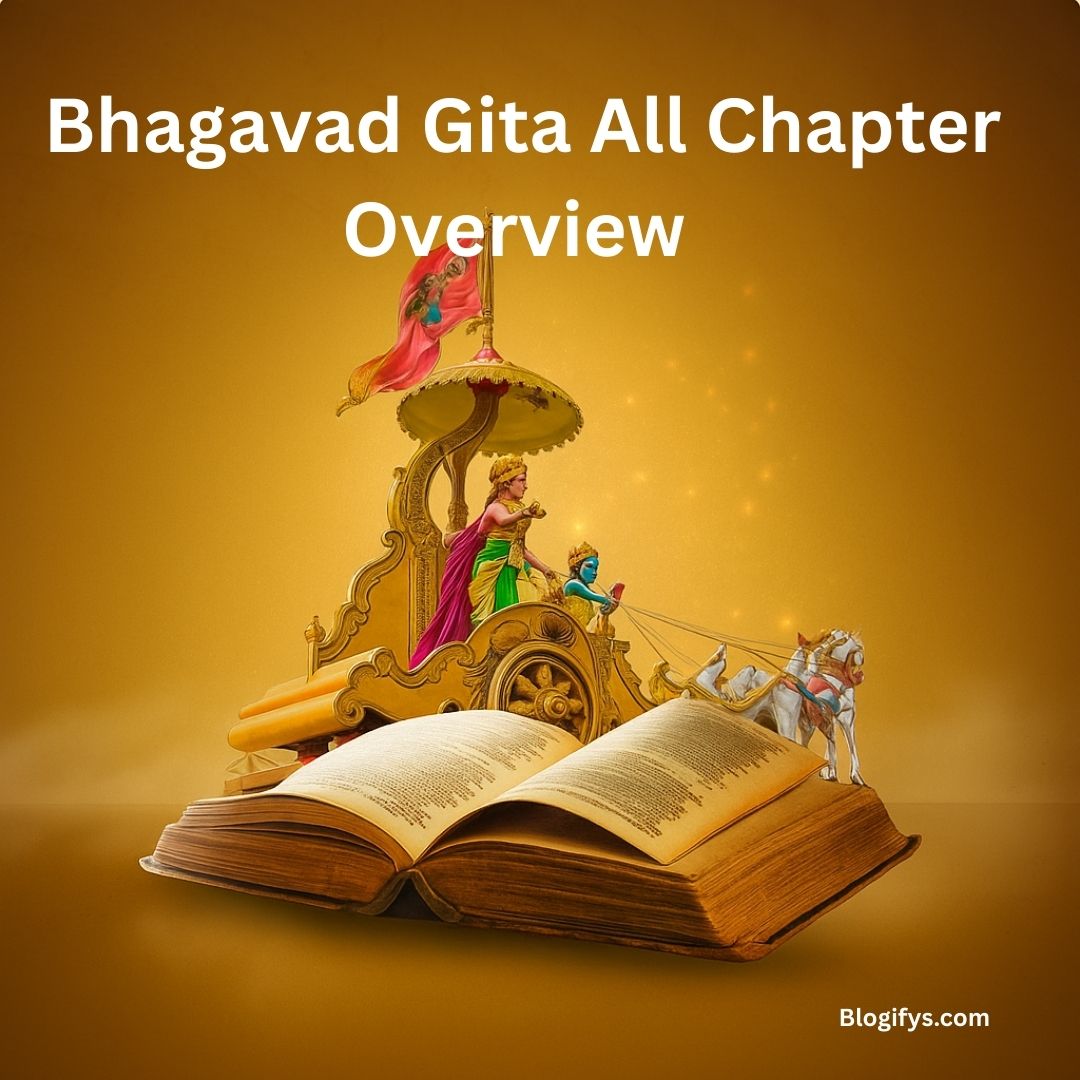
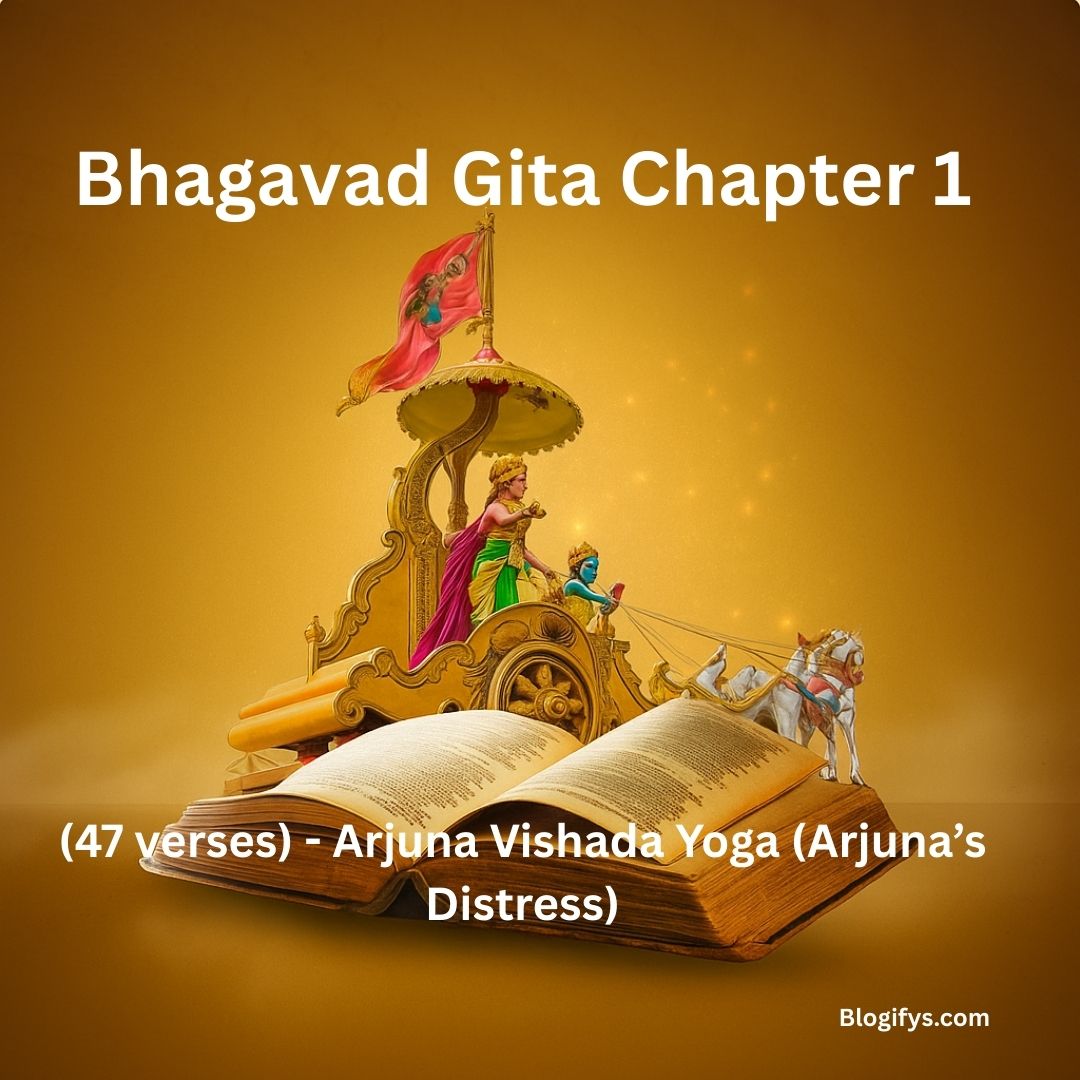
On the other side, both Lord Kåñëa and Arjuna, stationed on a great chariot
drawn by white horses, sounded their transcendental conchshells.
In contrast with the conchshell blown by Bhéñmadeva, the conchshells in
the hands of Kåñëa and Arjuna are described as transcendental. The sounding
of the transcendental conchshells indicated that there was no hope of victory
for the other side because Kåñëa was on the side of the Päëòavas. Jayas tu
päëòu-puträëäà yeñäà pakñe janärdanaù. Victory is always with persons like
the sons of Päëòu because Lord Kåñëa is associated with them. And whenever
and wherever the Lord is present, the goddess of fortune is also there because
the goddess of fortune never lives alone without her husband. Therefore,
victory and fortune were awaiting Arjuna, as indicated by the transcendental
sound produced by the conchshell of Viñëu, or Lord Kåñëa. Besides that, the
chariot on which both the friends were seated was donated by Agni (the firegod) to Arjuna, and this indicated that this chariot was capable of conquering
all sides, wherever it was drawn over the three worlds.
Verse 15
पाञ्चजन्यं हृषीकेशो देवदत्तं धनञ्जयः ।
पौण्ड्रं दध्मौ महाशङ्खं भीमकर्मा वृकोदरः ॥ १५ ॥
Then, Lord Kåñëa blew His conchshell, called Päïcajanya; Arjuna blew his, the
Devadatta; and Bhéma, the voracious eater and performer of Herculean tasks,
blew his terrific conchshell called Pauëòram.
Lord Kåñëa is referred to as Håñékeça in this verse because He is the owner
of all senses The living entities are part and parcel of Him, and, therefore, the
senses of the living entities are also part and parcel of His senses. The
impersonalists cannot account for the senses of the living entities, and
therefore they are always anxious to describe all living entities as sense-less, or
impersonal. The Lord, situated in the hearts of all living entities, directs their
senses. But, He directs in terms of the surrender of the living entity, and in the
case of a pure devotee He directly controls the senses. Here on the Battlefield
of Kurukñetra the Lord directly controls the transcendental senses of Arjuna,
and thus His particular name of Håñékeça. The Lord has different names
according to His different activities. For example, His name is Madhusüdana
because He killed the demon of the name Madhu; His name is Govinda
because He gives pleasure to the cows and to the senses; His name is Väsudeva
because He appeared as the son of Vasudeva; His name is Devaké-nandana
because He accepted Devaké as His mother; His name is Yaçodä-nandana
because He awarded His childhood pastimes to Yaçodä at Våndävana; His
name is Pärtha-särathi because He worked as charioteer of His friend Arjuna.
Similarly, His name is Håñékeça because He gave direction to Arjuna on the
Battlefield of Kurukñetra.
Arjuna is referred to as Dhanaïjaya in this verse because he helped his elder
brother in fetching wealth when it was required by the King to make
expenditures for different sacrifices. Similarly, Bhéma is known as Våkodara
because he could eat as voraciously as he could perform Herculean tasks, such
as killing the demon Hiòimba. So, the particular types of conchshell blown by
the different personalities on the side of the Päëòavas, beginning with the
Lord’s, were all very encouraging to the fighting soldiers. On the other side
there were no such credits, nor the presence of Lord Kåñëa, the supreme
director, nor that of the goddess of fortune. So, they were predestined to lose
the battle―and that was the message announced by the sounds of the
conchshells.
Verse 16–18
अनन्तविजयं राजा कुन्तीपुत्रो युधिष्ठिरः ।
नकुलः सहदेवश्च सुघोषमणिपुष्पकौ ॥
काश्यश्च परमेष्वासः शिखण्डी च महारथः ।
धृष्टद्युम्नो विराटश्च सात्यकिश्चापराजितः ॥
द्रुपदो द्रौपदेयाश्च सर्वशः पृथिवीपते ।
सौभद्रश्च महाबाहुः शङ्खान् दध्मुः पृथक् पृथक् ॥
King Yudhiñöhira, the son of Kunté, blew his conchshell, the Anantavijaya, and
Nakula and Sahadeva blew the Sughoña and Maëipuñpaka. That great archer
the King of Käçé, the great fighter Çikhaëòé, Dhåñöadyumna, Viräöa and the
unconquerable Sätyaki, Drupada, the sons of Draupadé, and the others, O King,
such as the son of Subhadrä, greatly armed, all blew their respective
conchshells.
Saïjaya informed King Dhåtaräñöra very tactfully that his unwise policy of
deceiving the sons of Päëòu and endeavoring to enthrone his own sons on the
seat of the kingdom was not very laudable. The signs already clearly indicated
that the whole Kuru dynasty would be killed in that great battle. Beginning
with the grandsire, Bhéñma, down to the grandsons like Abhimanyu and others
—including kings from many states of the world—all were present there, and
all were doomed. The whole catastrophe was due to King Dhåtaräñöra, because
he encouraged the policy followed by his sons.
Verse 19
स घोषो धार्तराष्ट्राणां हृदयानि व्यदारयत् ।
नभश्च पृथिवीं चैव तुमुलोऽभ्यनुनादयन् ॥ १९ ॥
The blowing of these different conchshells became uproarious, and thus,
vibrating both in the sky and on the earth, it shattered the hearts of the sons of
Dhåtaräñöra.
When Bhéñma and the others on the side of Duryodhana blew their respective
conchshells, there was no heart-breaking on the part of the Päëòavas. Such
occurrences are not mentioned, but in this particular verse it is mentioned
that the hearts of the sons of Dhåtaräñöra were shattered by the sounds
vibrated by the Päëòavas’ party. This is due to the Päëòavas and their
confidence in Lord Kåñëa. One who takes shelter of the Supreme Lord has
nothing to fear, even in the midst of the greatest calamity.
Verse 20
अथ व्यवस्थितान्दृष्ट्वा धार्तराष्ट्रान् कपिध्वजः ।
प्रवृत्ते शस्त्रसम्पाते धनुरुद्यम्य पाण्डवः ॥
हृषीकेशं तदा वाक्यमिदमाह महीपते ॥ २० ॥
O King, at that time Arjuna, the son of Päëòu, who was seated in his chariot,
his flag marked with Hanumän, took up his bow and prepared to shoot his
arrows, looking at the sons of Dhåtaräñöra. O King, Arjuna then spoke to
Håñékeça [Kåñëa] these words:
The battle was just about to begin. It is understood from the above
statement that the sons of Dhåtaräñöra were more or less disheartened by the
unexpected arrangement of military force by the Päëòavas, who were guided
by the direct instructions of Lord Kåñëa on the battlefield. The emblem of
Hanumän on the flag of Arjuna is another sign of victory because Hanumän
cooperated with Lord Räma in the battle between Räma and Rävaëa, and Lord
Räma emerged victorious. Now both Räma and Hanumän were present on the
chariot of Arjuna to help him. Lord Kåñëa is Räma Himself, and wherever
Lord Räma is, His eternal servitor Hanumän and His eternal consort Sétä, the
goddess of fortune, are present. Therefore, Arjuna had no cause to fear any
enemies whatsoever. And above all, the Lord of the senses, Lord Kåñëa, was
personally present to give him direction. Thus, all good counsel was available
to Arjuna in the matter of executing the battle. In such auspicious conditions,
arranged by the Lord for His eternal devotee, lay the signs of assured victory.
Verse 21–22
अर्जुन उवाच
सेनयोरुभयोर्मध्ये रथं स्थापय मेऽच्युत ।
यावदेतानिरीक्षेऽहं योद्धुकामानवस्थितान ॥ २१ ॥
कैर्मया सह योद्धव्यमस्मिन् रणसमुद्यमे ॥ २२ ॥
Arjuna said: O infallible one, please draw my chariot between the two armies so
that I may see who is present here, who is desirous of fighting, and with whom
I must contend in this great battle attempt.
Although Lord Kåñëa is the Supreme Personality of Godhead, out of His
causeless mercy He was engaged in the service of His friend. He never fails in
His affection for His devotees, and thus He is addressed herein as infallible. As
charioteer, He had to carry out the orders of Arjuna, and since He did not
hesitate to do so, He is addressed as infallible. Although He had accepted the
position of a charioteer for His devotee, His supreme position was not
challenged. In all circumstances, He is the Supreme Personality of Godhead,
Håñékeça, the Lord of the total senses. The relationship between the Lord and
His servitor is very sweet and transcendental. The servitor is always ready to
render a service to the Lord, and, similarly, the Lord is always seeking an
opportunity to render some service to the devotee. He takes greater pleasure in
His pure devotee’s assuming the advantageous position of ordering Him than
He does in being the giver of orders. As master, everyone is under His orders,
and no one is above Him to order Him. But when he finds that a pure devotee
is ordering Him, He obtains transcendental pleasure, although He is the
infallible master of all circumstances.
As a pure devotee of the Lord, Arjuna had no desire to fight with his cousins
and brothers, but he was forced to come onto the battlefield by the obstinacy
of Duryodhana, who was never agreeable to any peaceful negotiation.
Therefore, he was very anxious to see who the leading persons present on the
battlefield were. Although there was no question of a peacemaking endeavor
on the battlefield, he wanted to see them again, and to see how much they
were bent upon demanding an unwanted war.
Verse 23
योत्स्यमानानवेक्षेऽहं य एतेऽत्र समागताः।
धार्तराष्ट्रस्य दुर्बुद्धेर्यु द्धे प्रियचिकीर्षवः॥ 23 ॥
Let me see those who have come here to fight, wishing to please the evilminded son of Dhåtaräñöra.
It was an open secret that Duryodhana wanted to usurp the kingdom of the
Päëòavas by evil plans, in collaboration with his father, Dhåtaräñöra.
Therefore, all persons who had joined the side of Duryodhana must have been
birds of the same feather. Arjuna wanted to see them in the battlefield before
the fight was begun, just to learn who they were, but he had no intention of
proposing peace negotiations with them. It was also a fact that he wanted to
see them to make an estimate of the strength which he had to face, although
he was quite confident of victory because Kåñëa was sitting by his side.
Verse 24
सञ्जय उवाच
एवमुक्तो हृषीकेशो गुडाकेशेन भारत ।
सेनयोरुभयोर् मध्ये स्थापयित्वा रथोत्तमम् ॥ २४ ॥
Saïjaya said: O descendant of Bharata, being thus addressed by Arjuna, Lord
Kåñëa drew up the fine chariot in the midst of the armies of both parties.
In this verse Arjuna is referred to as Guòäkeça. Guòäka means sleep, and
one who conquers sleep is called guòäkeça. Sleep also means ignorance. So
Arjuna conquered both sleep and ignorance because of his friendship with
Kåñëa. As a great devotee of Kåñëa, he could not forget Kåñëa even for a
moment, because that is the nature of a devotee. Either in waking or in sleep, a
devotee of the Lord can never be free from thinking of Kåñëa’s name, form,
quality and pastimes. Thus a devotee of Kåñëa can conquer both sleep and
ignorance simply by thinking of Kåñëa constantly. This is called Kåñëa
consciousness, or samädhi. As Håñékeça, or the director of the senses and mind
of every living entity, Kåñëa could understand Arjuna’s purpose in placing the
chariot in the midst of the armies. Thus He did so, and spoke as follows.